One Task — Three Solutions: How to Choose a Grain Flow Distribution System for a Grain Elevator
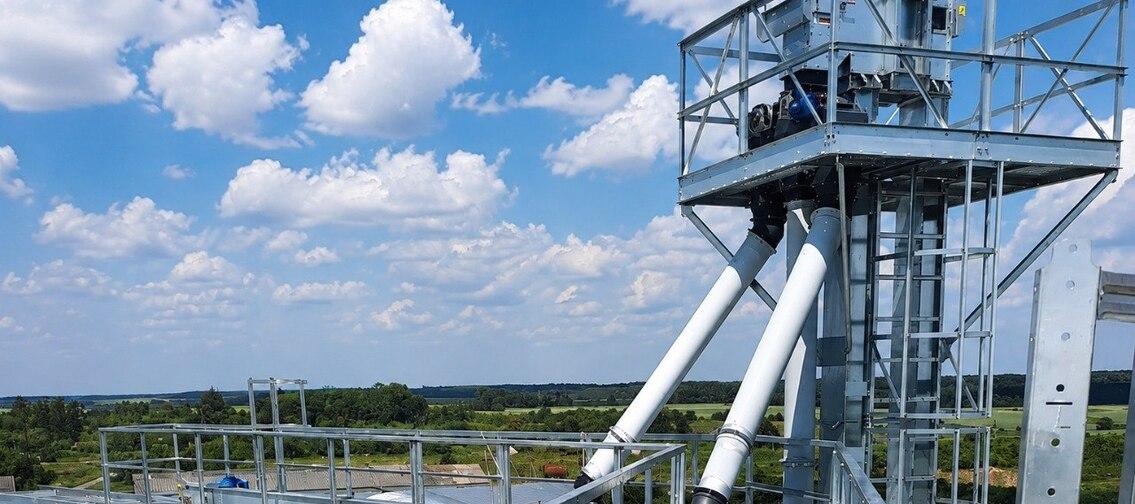
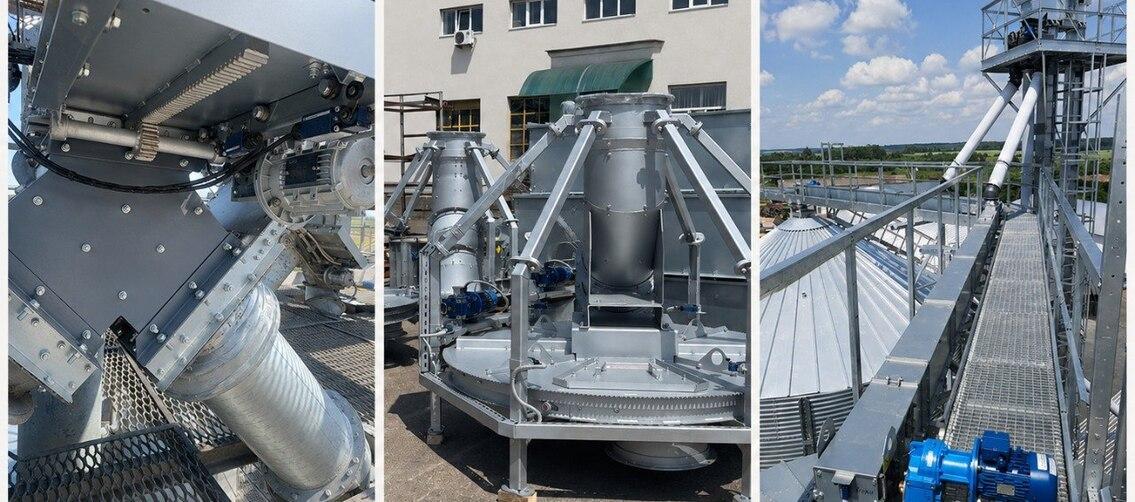
There are several ways to distribute grain flow between multiple process routes. At grain handling facilities, this is typically done using diverter valves, rotary distributors, or an inlet system with rack-and-pinion slide gates.
It is important to move away from classifying these solutions as “old” or “modern.” Rotary distributors were already widely used in Soviet-era grain handling facilities, while diverter valves also remain a relevant and widely used solution today. The key question is therefore not the generation of the technology, but which solution best suits a specific process layout.
At first glance, the task is the same — to direct the product to the required route. However, each solution has a different impact on equipment layout, the ability to operate directly within the product flow, residual product, automation, system behavior in the event of a failure, and overall cost.
Therefore, the first step should be to consult an experienced process engineer and clearly define how the facility intends to use this unit.
Transport and process line — no more than 4 flows
| Solution | Operating principle | Advantages | Limitations |
|---|---|---|---|
| Diverter valves | Sequential switching of the product flow between directions using one of the valves. |
• Flexible system configuration.
• Switching points can be located at different elevations.
• If one valve fails, the system can be partially reconfigured when alternative routes are available.
|
• With 6–8 or more directions, the number of equipment units, drives and service points increases.
• More vertical space is required.
• The cost of the unit increases as the number of routes grows.
|
| Rotary distributor | A single inlet pipe is positioned at the required outlet by means of a drive and positioning system. |
• Compact solution for a large number of directions from a single point.
• Fewer drives and automation points.
• For 6–8 directions, the unit cost is lower than that of a cascade of valves.
|
• If the switching mechanism fails, switching between routes is unavailable.
• Depending on the type of failure, one fixed route may remain available for operation.
• One unit serves several directions simultaneously.
|
| Inlets with rack-and-pinion slide gates | The product is directed by opening the required inlet or rack-and-pinion slide gate in the distribution system. |
• Switching and operation directly in the product flow.
• Relatively simple design.
• Suitable for systems with several directions.
|
• Residual product remains in the units and gravity chutes.
• When changing crops, contamination with residues of the previous crop is possible.
• Slide gates and product accumulation zones require monitoring.
|
With a small number of routes, the process task can be implemented in several ways.
For up to four directions, the choice is determined primarily by the facility’s operating process. In one case, routing flexibility may be the priority; in another, a compact unit layout; and in a third, the ability to switch routes directly during product flow.
When the number of directions increases to 6–8, another important criterion is added to the technological considerations — economics.
What changes when the number of routes increases to 6–8
For 6 routes, the following configurations can be used:
- one rotary distributor with 6 outlets;
- or two three-way diverter valves and one symmetrical diverter valve.
With the same lined design, the rotary distributor in this configuration costs approximately 16% less than the set of valves.
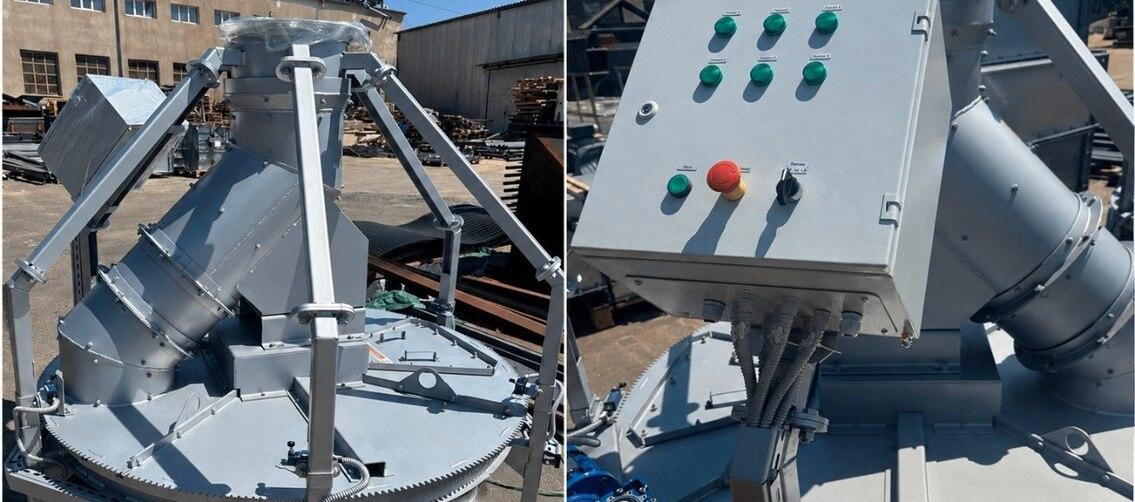
For 8 routes, we compare:
- one rotary distributor with 8 outlets;
- or three three-way diverter valves and one symmetrical diverter valve.
In this configuration, a lined rotary distributor costs approximately 26% less than the required set of valves.
In other words, as the number of directions increases, the economics change. A single valve does indeed cost less than a rotary distributor, but when comparing solutions for the same process task, it is necessary to consider the complete equipment package rather than individual units.
Equipment cost is not the total cost of the entire unit
A cascade of several valves means more than just a greater number of individual mechanisms. Each valve requires a drive, position monitoring, connection to the automation system, as well as sufficient space for the equipment and gravity-flow chutes.
A rotary distributor combines several directions within a single unit, which, in certain layouts, can reduce the number of drives, connection points, and the vertical space required.
Therefore, it is more accurate to compare not only the purchase price of the equipment, but the cost of the entire unit: equipment + gravity-flow chutes + steel structures + automation + electrical installation + mechanical installation.
When the complete system cost is considered, the difference between the solutions may prove to be greater than the 22–26% obtained from a direct comparison of equipment costs alone.
Dead residue: when a simple solution creates a process problem
Inlet systems with rack-and-pinion slide gates deserve separate consideration.
Their key advantage is the ability to operate directly within the product flow. However, this configuration has another limitation: once conveying is completed, some product remains inside the unit.
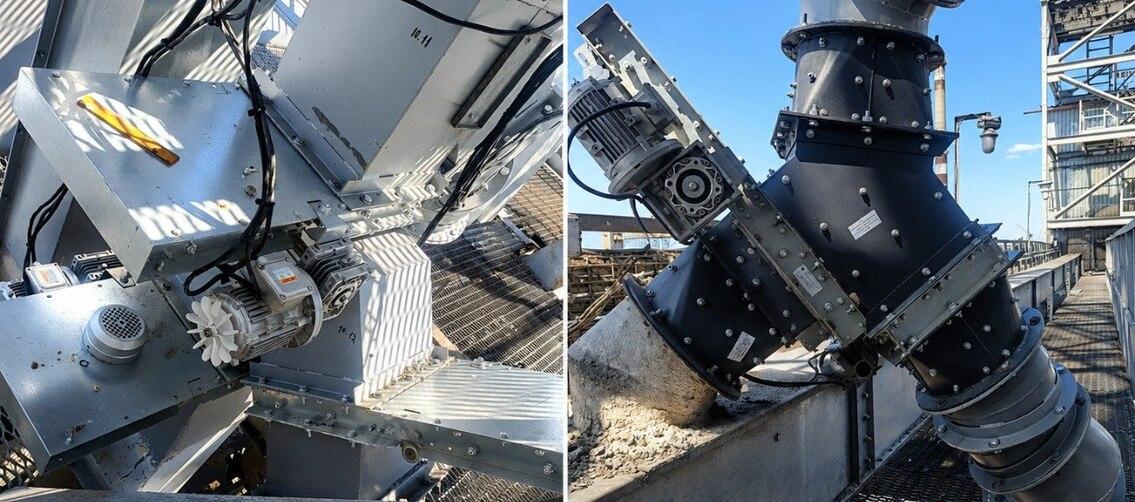
If a facility primarily handles a single crop, this may not be a critical issue. However, when crops are changed regularly, residues from the previous batch will enter the next one.
For example, if the route is switched from wheat to corn, the remaining wheat becomes an impurity in the new batch.
Therefore, for facilities that handle a wide range of crops or have strict requirements for batch purity, the risk of cross-contamination may be more important than the difference in equipment cost.
What happens in the event of a failure
For a high-throughput grain elevator, it is important to assess not only CAPEX, but also how the process layout will perform in the event of a failure.
In a diverter valve system, the failure of a single mechanism is more localized. If alternative routes are provided by the process layout, some of the flows can be rerouted and operation can continue.
With a rotary distributor, a failure of the positioning system may result in the loss of the ability to switch between different directions. However, this does not necessarily mean a complete shutdown of the grain elevator: depending on the nature of the failure, one route can be kept in a fixed position and operation can continue through it.
Therefore, the key difference lies not so much in the reliability of the equipment itself, but in the flexibility of the process layout in the event of a failure.
Not equipment for the route, but a solution for the business
There is no universal solution. What is optimal for one agricultural facility may be unsuitable for another due to differences in operating intensity, the range of crops handled, acceptable downtime, staff qualifications, and future development plans.
That is why the grain flow distribution system should be considered at the design stage as an integral part of the overall process layout. The key objective is not simply to move grain from point A to point B, but to ensure that the selected solution remains efficient under real grain elevator operating conditions.
If the grain elevator is already in operation but the existing layout limits capacity, does not provide sufficient routing flexibility, causes downtime, or complicates the handling of different crops, it may be time to consider modernization.
Grain Capital has many years of experience in the design and modernization of grain elevator complexes. As part of an engineering audit, the team analyzes existing and potential routes, equipment utilization, redundancy options, and bottlenecks to determine which changes can deliver tangible technological and economic benefits to the facility.